







For nearly two decades, the Electronic Discovery Reference Model (EDRM) has served as one of the most recognizable frameworks in the legal and technology communities. Its success stems from its simplicity: a clear, accessible representation of the eDiscovery process that can be understood by judges, attorneys, technologists, students, investigators, and information governance professionals alike.
As the EDRM 2.0 model enters public comment, the proposed updates present an important opportunity to maintain that accessibility while better reflecting the realities of modern legal practice, advances in technology, and the future direction of information governance and discovery. The changes mirror the tested and proven methods we follow at UnitedLex, and as a committee member of the EDRM 2.0 Project, there are five main updates I consider worth covering in detail:
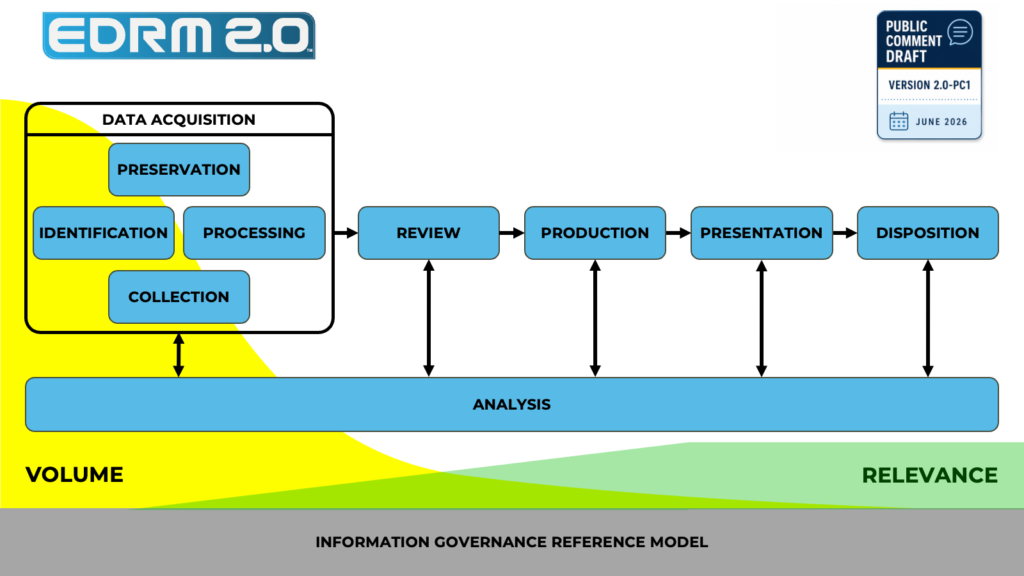
- Emphasizing data collection as a cyclical process
- Underpinning analysis in every step of the workflow
- Acknowledging that relevance is identified earlier and earlier in the process
- Adding data disposition as an additional, last step
- Building the model on top of the framework of the Information Governance Reference Model
Preserving Simplicity While Embracing Progress
The original EDRM became an industry standard because it translated complex legal and technical workflows into a visual framework that was intuitive and easy to understand. The evolution of the model to its 2.0 form honors that purpose.
The objective of EDRM 2.0 is not to reinvent the eDiscovery process, but rather to modernize its representation. The updated model preserves the educational value and universal understanding established by EDRM 1.0 while accurately depicting how organizations now identify, collect, analyze, review, and manage electronically stored information (ESI).
The proposed changes align to eDiscovery of today and modern legal workflows, which have changed considerably since the original model was created.
From Linear Workflows to Continuous Discovery
One of the most significant improvements in EDRM 2.0 is the increased emphasis on the data collection phase as a cyclical process rather than a linear one.
Traditional representations of eDiscovery often suggest a step-by-step progression from information governance through production and presentation. However, practitioners know that modern matters rarely follow such a straightforward path
New custodians are identified. Additional data sources emerge. Investigations expand or narrow. Analytics uncover information that triggers additional collection efforts and as a result, eDiscovery has become increasingly iterative.
By emphasizing data collection within a cyclical framework, EDRM 2.0 more accurately reflects today’s reality: discovery is a continuous process of assessment, refinement, and validation rather than a one-way journey.
Elevating Analysis as a Core Component
The model has advanced to recognize that analysis is not merely a supporting activity but a foundational component of the entire eDiscovery lifecycle.
Historically, organizations often viewed analysis as occurring after collection and before review. Today’s technology-driven workflows tell a different story.
Whether leveraging email threading, communication mapping, entity extraction, sentiment analysis, technology-assisted review (TAR), continuous active learning (CAL), or advanced analytics, organizations increasingly rely on analysis throughout every phase of discovery.
By depicting analysis as a major process that can occur across multiple — and oftentimes all — stages, EDRM 2.0 more accurately reflects current best practices and emerging capabilities.
Relevance Is Identified Earlier Than Ever
One of the most notable shifts in modern discovery is the ability to identify potentially relevant information much earlier in the process.
When the original EDRM was introduced, determining relevance was heavily concentrated during document review. Today, advanced technologies enable legal teams to make relevance assessments significantly earlier.
Data identification tools, Early Case Assessment (ECA), TAR, Generative AI, and sophisticated analytics allow organizations to evaluate data populations before extensive collection, processing, or review activities happen.
The proposed depiction of relevance through the intersection points represented by the model’s triangular structures appropriately recognizes this evolution. Relevance is no longer a downstream determination. Instead, it increasingly influences decision-making from the earliest stages of the matter.
This change acknowledges a fundamental reality of modern discovery: better technology enables smarter decisions sooner.
Data Disposition Deserves a Place in the Model
Including a dedicated disposition phase is perhaps the most important addition to EDRM 2.0.
Organizations face unprecedented data growth. The challenge is no longer simply finding relevant information, it is managing enormous volumes of information responsibly, defensibly, and cost-effectively.
Data disposition has become a critical consideration for eDiscovery as well as broader information governance strategies. Once legal holds are released and obligations have been satisfied, organizations must determine what data should be retained, archived, or disposed of according to policy and regulatory requirements.
Including data disposition in the model reflects a growing industry recognition that defensible deletion is as important as defensible preservation.
Importantly, it reinforces that discovery responsibilities do not end when a matter concludes. The decisions made after litigation can have significant impacts on future legal, operational, and compliance risks.
The Critical Role of IGRM
Another valuable enhancement that directly relates to including Data Disposition is explicit recognition of the Information Governance Reference Model (IGRM) as an overarching influence across the eDiscovery lifecycle.
Information governance is no longer a separate discipline operating independently from legal discovery. The two have become deeply interconnected and are components of the same information lifecycle.
Data retention policies, privacy requirements, security controls, classification strategies, and lifecycle management decisions all directly influence discovery outcomes. Likewise, discovery lessons often inform governance improvements.
By illustrating the IGRM as a framework that encompasses and guides the eDiscovery process, EDRM 2.0 acknowledges the reality that effective discovery begins long before litigation and continues after a matter is resolved.
Looking Ahead with UnitedLex
EDRM 2.0 is an important evolution of a model that has educated and guided the industry for years. The proposed updates preserve the core strength of the original — the ability to communicate complex concepts simply — while aligning the framework with the modern legal, technological, and governance realities we see today.
By emphasizing the cyclical nature of discovery, elevating the role of analysis, recognizing earlier relevance determinations, introducing data disposition, and highlighting the overarching influence of the IGRM, the updated model better reflects how UnitedLex looks at discovery and where the industry is headed.
In practice, our Forensic Consultants work with clients through the data collection process, iterating on and confirming the targeted collection needs. With an AI-forward approach to data, our technology, people and processes work together providing First Look, ECA, RAPID Review, RAPID Privilege, and RAPID Redact to get relevance determinations through review and production. With RAPID Evidence, we assist with Presentation, ensuring clients have the witness kits, timelines, chronologies, and documents needed for trial. At the end of each case, we work on Data Disposition and even identify opportunities for Data Reuse on similar matters. Our maturity assessments and consulting options take a holistic approach to look at how organizations store data, their obligations and how to provide measurable value to the business through these processes.
Overall, EDRM 2.0 continues the original mission of making eDiscovery understandable for everyone by providing a framework that can evolve with the technologies and practices shaping legal discovery and by aligning with industry best practices.