







Brain–Computer Interfaces (BCIs) constitute a multidisciplinary technology domain combining neuroscience, biomedical engineering, signal processing, artificial intelligence, materials science, and human–machine interaction. A BCI enables direct communication or control pathways between neural tissue and external computational or electromechanical systems by translating neural signals into actionable commands and, in advanced systems, providing feedback to the nervous system. For decades, Brain–Computer Interfaces (BCIs) lived comfortably at the edge of science fiction and academic neuroscience. Today, they are quietly crossing a threshold that matters far more to industry than to futurists: commercial viability.
The BCI story is no longer just about reading neurons or restoring movement. It is increasingly about who controls human intent in digital and physical systems, and how that control translates into revenue, platforms, and long-term strategic advantage. According to Morgan Stanley’s 2024 BCI Primer report, BCI market presents a $400B opportunity in the USA alone, targeting 3 million potential users for first-generation commercial devices and 7 million for subsequent generations, with motor impairment patients as the initial beachhead — focusing on neurodegenerative diseases (such as ALS), spinal cord injury, multiple sclerosis, and stroke. Projections indicate $1.5B in revenue from implantable BCI procedures by 2035, prioritizing healthcare applications in the mid-term while eyeing long-term expansion into consumer sectors like military, gaming, and productivity.
A typical BCI system consists of four interconnected layers.
- Neural signal acquisition, which captures brain activity through invasive, minimally invasive, or non-invasive interfaces.
- Signal conditioning and preprocessing, where neural data is amplified, filtered, and cleaned to improve signal quality.
- Neural decoding and interpretation, increasingly powered by machine learning and AI models that infer user intent from neural activity.
- Output and feedback layer translates decoded intentions into actions such as device control, communication, or therapeutic stimulation, often operating in a closed-loop feedback system.
Evolving Global Patent Landscape
The patent landscape demonstrates rapid growth and maturation. Analysis of more than 8,500 patents and applications reveals three major phases of industry evolution.
- Exploratory Phase (pre-2010) focused on foundational signal acquisition, stimulation, and proof-of-concept technologies.
- Translational Phase (2010–2017) practical applications in neuroprosthetics, rehabilitation, and assistive communication.
- Platform and Ecosystem Phase (2018 – present) characterized by growth in AI-driven decoding, scalable hardware, closed-loop systems, and integrated software platforms.
Geographically, the competitive landscape is highly differentiated. The United States maintains leadership in high-performance invasive BCIs, supported by strong portfolios, substantial clinical validation efforts, and well-developed regulatory strategies. Companies such as Neuralink and Synchron exemplify this approach. China leads in filing volume, driven largely by universities and state-affiliated research institutions producing extensive portfolios in neural signal acquisition and interpretation. Europe is particularly strong in neuroprosthetics, rehabilitation, and biomedical engineering, benefiting from deep medical expertise and rigorous regulatory frameworks. Meanwhile, Japan and South Korea focus on wearable and consumer-oriented BCIs that integrate with robotics and advanced manufacturing systems.
The industry can be divided into three major categories of players: neurotechnology startups, large technology platforms, and medical device companies.
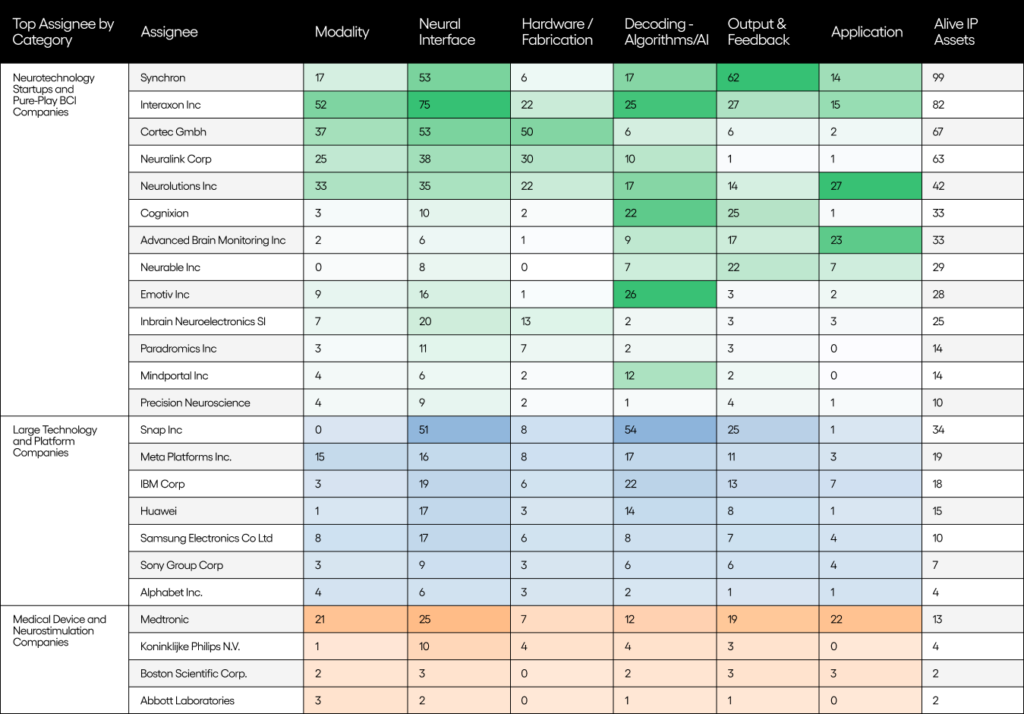
Neurotechnology startups and pure-play BCI companies such as Neuralink, Synchron, Precision Neuroscience, Cognixion, Paradromics, and Inbrain Neuroelectronics focus on core technical innovation. Their portfolios emphasize neural interfaces, implantable hardware, surgical systems, and advanced decoding technologies. Neuralink has concentrated on high-density electrode arrays, robotic implantation technologies, and integrated implant hardware. Synchron has pioneered minimally invasive endovascular implants delivered through blood vessels, eliminating the need for open-brain surgery. Cognixion is developing AI-enhanced communication systems that combine neural decoding with large language models to assist patients with severe speech impairments. These startups generally pursue deep specialization while seeking partnerships to expand into adjacent layers of the BCI stack.
Large technology and platform companies such as Meta, Snap, Samsung, Sony, IBM, Huawei, and Alphabet approach BCIs as extensions of broader computing platforms. Their focus is less on medical restoration and more on enhancing human-computer interaction. Meta and Snap are heavily invested in incorporating neural inputs into AR/VR and extended reality ecosystems. Samsung is exploring neural control of wearable robotic systems, while Sony is investigating context-aware interaction systems powered by multimodal neural models. IBM and Huawei concentrate on enabling infrastructure, cybersecurity, signal processing, and platform stability. Their long-term objective is to make BCI functionality an integrated component of future computing ecosystems rather than a standalone technology.
Medical device and neurostimulation companies, including Medtronic, Philips, Boston Scientific, and Abbott, focus on therapeutic applications. Their expertise lies in implant reliability, regulatory compliance, neurostimulation, and long-term patient care. A major area of development is closed-loop neurostimulation, where devices monitor neural activity and automatically adjust therapy parameters for conditions such as Parkinson’s disease, chronic pain, mood disorders, and sleep-related conditions. Unlike technology companies, their innovation is tightly aligned with clinical outcomes and healthcare delivery.
Commercial and Strategic Positions of Leading Players
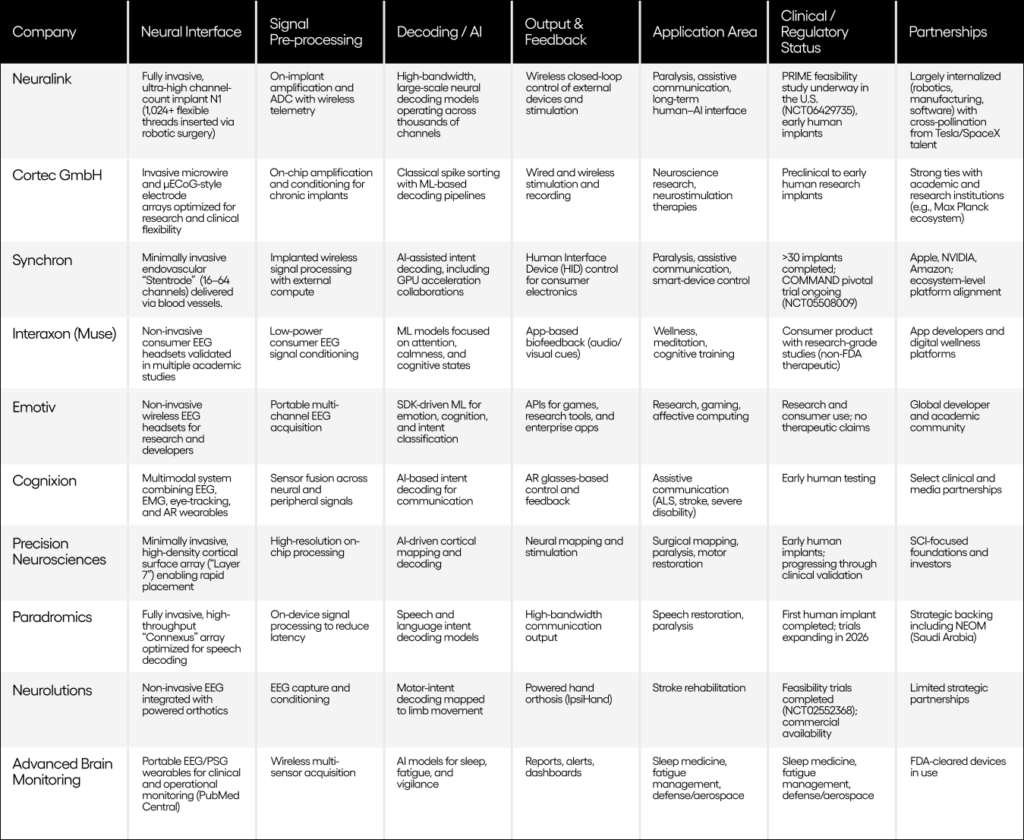
The table below summarizes the key technology focus areas, primary application areas of the BCI products being researched and developed by the top BCI companies. Progress in clinical trials and collaboration/partnerships with other technology companies have been noted to understand the future initiatives.
AI-driven acceleration in the domain
Artificial Intelligence has emerged as the critical enabling layer across the entire BCI value chain. While neural interfaces generate raw brain signals, AI transforms those signals into actionable intent by performing signal conditioning, pattern recognition, intent decoding, prediction, and adaptive learning. Modern BCI systems increasingly rely on deep learning architectures capable of identifying subtle neural patterns across thousands of channels and continuously adapting to individual users. Beyond motor-control applications, AI is enabling higher-level cognitive functions such as speech reconstruction, intent prediction, and contextual decision-making. Companies such as Synchron and Cognixion are integrating Generative AI and Large Language Models (LLMs) into BCI platforms to convert neural intent into natural language communication for patients with severe speech impairments. Similarly, Neuralink, Precision Neuroscience, and Paradromics are developing AI-driven decoding systems to improve motor restoration and speech generation accuracy.
As hardware technologies gradually converge, proprietary AI models and longitudinal neural datasets are becoming key sources of competitive differentiation, creating a powerful feedback loop in which better data improves algorithms, improved algorithms enhance outcomes, and enhanced outcomes accelerate adoption. Consequently, AI is evolving from a supporting technology into the primary value-creation layer within the BCI ecosystem and a central driver of future commercial advantage.
Conclusion
The global BCI patent landscape is rapidly consolidating around vertically integrated platforms rather than standalone neuro-hardware innovations. In brain–computer interfaces (BCIs), technical breakthroughs in neural sensing or decoding are increasingly necessary but insufficient for long-term advantage. Hardware technologies are gradually converging, while AI advances increasingly diffuse across the industry. As a result, sustainable competitive advantage will come from integrated platforms that combine neural interfaces, software, clinical validation, regulatory expertise, and proprietary neural datasets. Companies that successfully create end-to-end systems will develop stronger intellectual property portfolios, more effective products, and greater barriers to entry. Ultimately, the defining competitive race in BCIs is not simply to read minds, but to own the stack that transforms neural intent into practical, scalable applications.