







Quantum computing is both a technology and a scientific race. It is also a national security issue and a growing soapbox race to claim ownership of the ideas behind quantum computing. Organizations like IBM, Google, IonQ, and the University of Science and Technology of China (USTC) are racing to patent everything from chip architecture to algorithms to quantum computation methods to correct errors, in the rush to get patents that will allow their innovations to be used in real-world applications. In this article, we look at who is asserting what within quantum computing, why they are taking enforcement action, and how these IP maneuvers stress the need for organizations to have a sound patent strategy when making scientific breakthroughs.
Quantum Computing: A Quick Intro
Before we dig into who owns what in quantum computing is, it is important to understand what quantum computing is and, more importantly, what parts of quantum computing can be claimed as intellectual property. The simplest explanation is that a conventional computer uses 0s and 1s (bits) to represent data, but a quantum computer will use something called a qubit that has a quantum property called superposition that makes it exist in state 0 or 1 or, technically, exist in both states until it is measured.
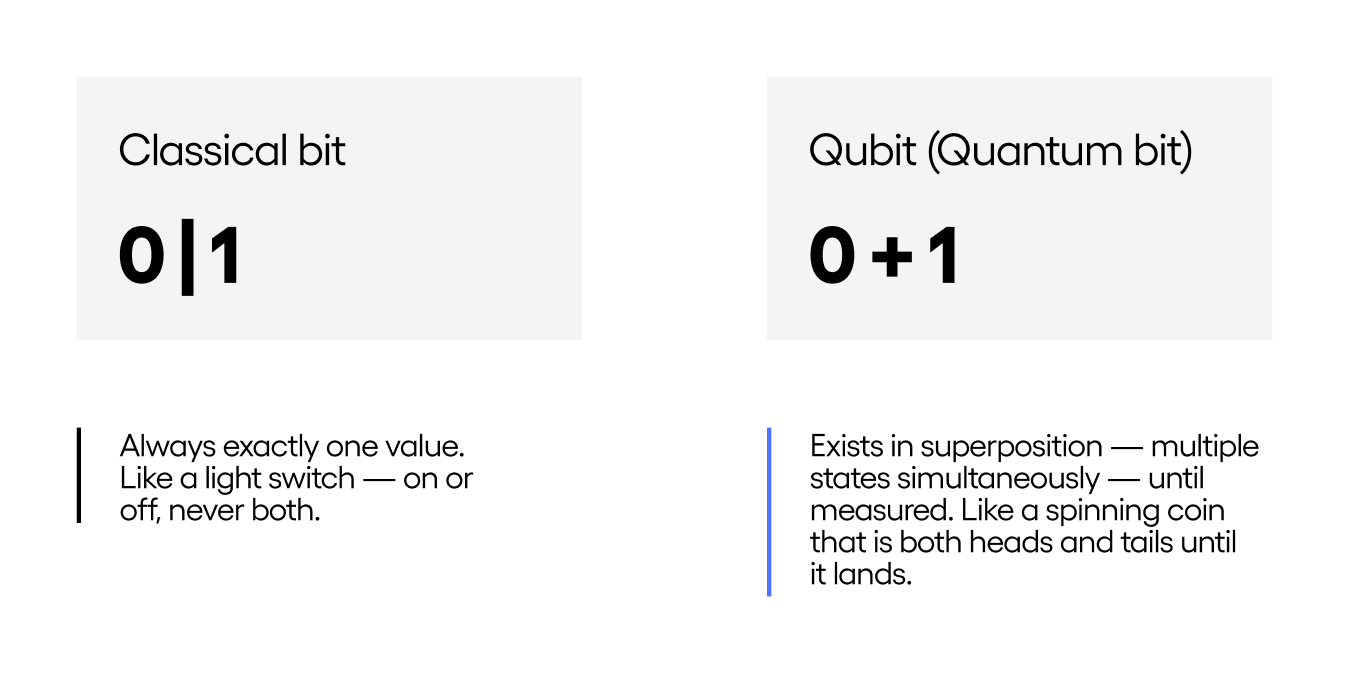
In essence, quantum computers are fundamentally different, they exploit quantum physics to explore many solutions at once, and that could be a major key for AI. Training large models today is like a battle against the terrain. The algorithms get stuck in suboptimal solutions and require substantial computing power and time to find better ones. Quantum might help find ways to navigate the terrain more efficiently, and it might accelerate the heavy math at the heart of model training and probabilistic reasoning required for AI and other emerging technology.
IP Ownership Battleground
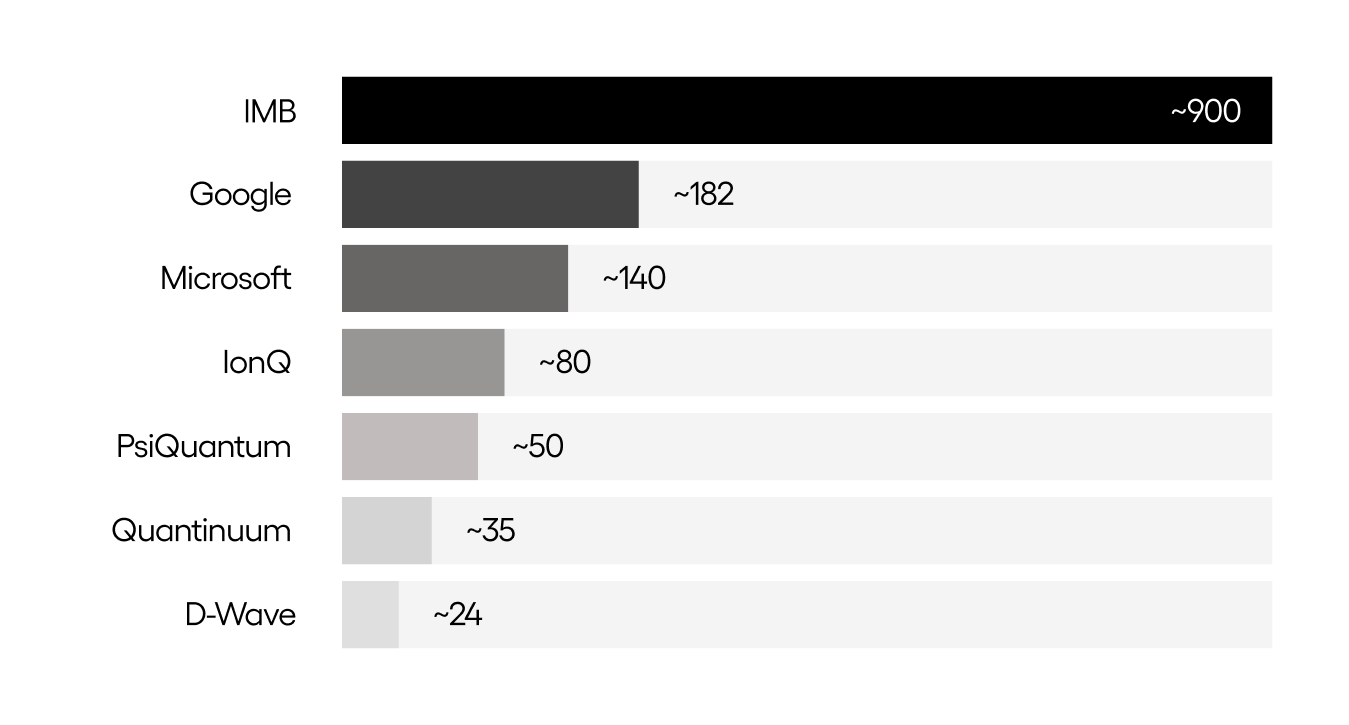
The ownership war is already underway. Patent offices in Washington, Munich, Beijing, and Tokyo are grappling with the same uncomfortable fact. The quantum computing patent race is years ahead of the technology. In 2025 alone, IBM has been granted about 900 quantum patents, while Google has been granted about 182[1], and the country of Mainland China holds about 60% of all quantum technology patents filed around the world[2]. Yet, the technology these patents describe: a fault-tolerant, practically useful quantum computer, does not exist. We have seen similar patterns occur throughout the history of technology. One classic example is with the radio, there was a substantial number of radio patents established before any device had demonstrated clear signaling.
Determining who leads the way is more a question of what defines “leading” in this sense. In raw numbers, IBM has the most patents, and Google has the second-most. But the number of patents is not the most interesting part: No other competitor comes close to matching even half of IBM’s patent footprint.
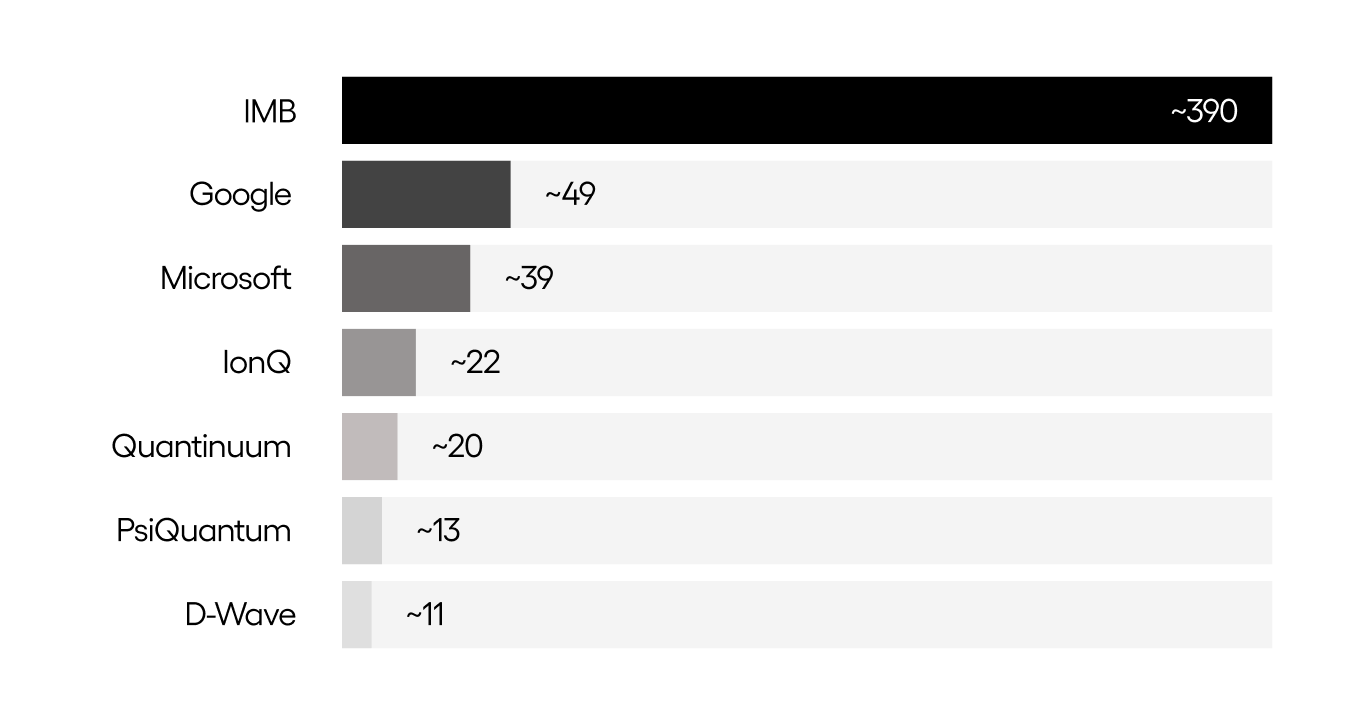
In 2026 [1]:
In 2025 [1]:
In 2024 [1]:
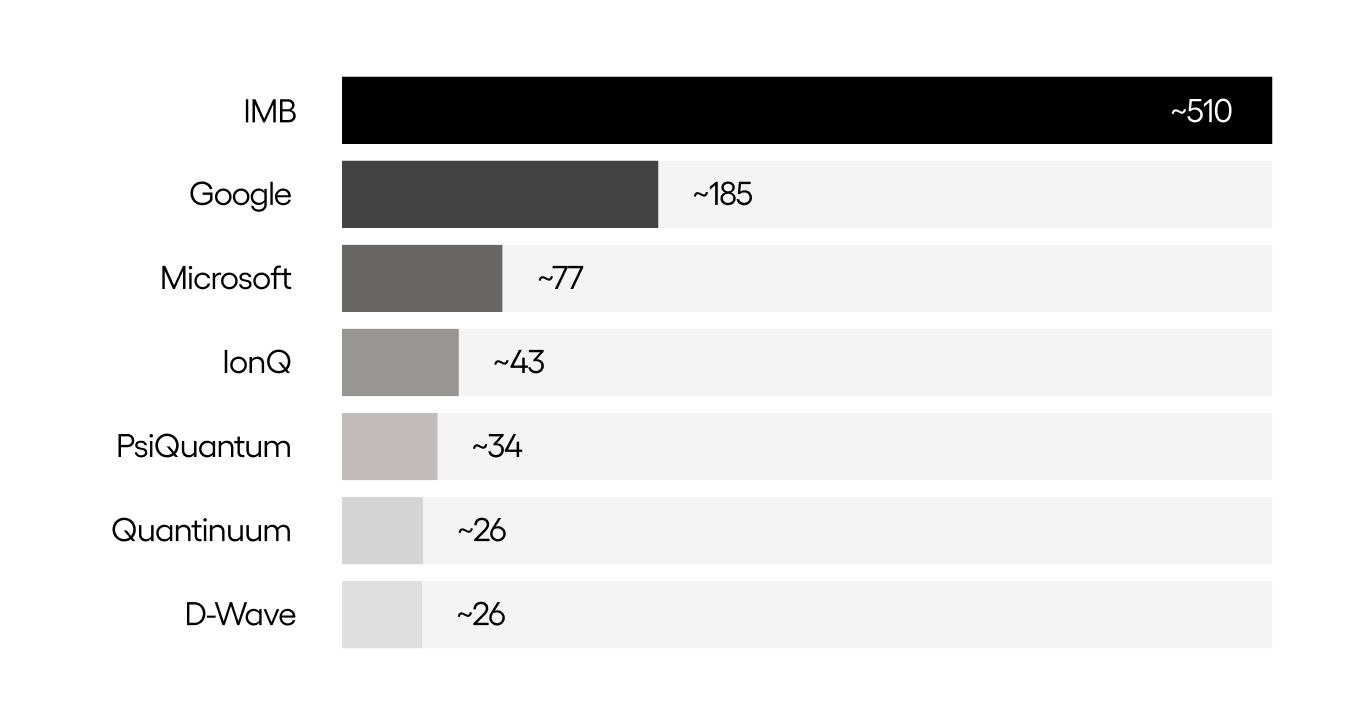
The quantum patent landscape from 2024-26 reveals key aspects of how differently the players approach their IP strategy. IBM has nearly doubled the number of granted patents, from 510 to 900 (78% growth), and Microsoft has expanded from 77 to 140 (82% growth). Furthermore, Microsoft secured an estimated 39 patents in the first quarter of 2026, underscoring its continued investment in topological qubits and network infrastructure. an estimated number of 39 patents, highlighting their investment in topological qubits and network infrastructure.
A massive patent portfolio is not necessarily proof of technological superiority, but it is an incredibly effective tool for market control. Even a competitor with copious funding and a superior quantum processor will eventually run into foundational patents held by early players like IBM. This shows that raw patent volume is not just about claiming to be first, it is about creating a legal boundary that competitors must pay to cross.
Clearing a Path to Creating Value
As companies and innovators race on with their heads down, the IP landscape begins to look more like a rose thicket than a blue ocean of opportunity. The patent thicket refers to when a given field of technology becomes oversaturated with patents that create a mess of licensing entanglements for anyone who wants to develop a product in that field. Pharmaceuticals & Biotechnology, Logistics & Supply Chain, and Finance & Banking are prime examples. If you are a quantum computing startup in Bengaluru, Berlin, or Boston today, your challenge is real. Nearly any hardware architecture you design will probably involve patents owned by IBM, Google, or both. This means you will likely find yourself negotiating licenses with two of the largest, most influential technology companies in the world before you have a single paying customer.
The next patent filed could be the most important in history, with the person who gets to the patent office first holding a degree of leverage unrivaled by any other in history. There is still a ways to go, though. Qubits are fussy and for the most part, the machines are not working. Nonetheless, quantum computing remains a rapidly evolving area of technology for which, patent by patent, companies are clearing their path in the race for intellectual property rights (IPR) for both quantum computing algorithms and hardware designs.
As a leader in IP research, UnitedLex has become an indispensable provider of IPR services, including patentability searches, freedom-to-operate searches, and landscape analysis for researchers and companies trying to sift through complex patent portfolios and identify opportunities for innovation. We specialize in helping companies define and implement IP strategies that create real value. Contact us here to discuss your portfolio.
[1] https://derwentinnovation.clarivate.com.cn/login/
[2] https://www.uspto.gov/patent/laws-and-regulations/examination-policy/subject-matter-eligibility