






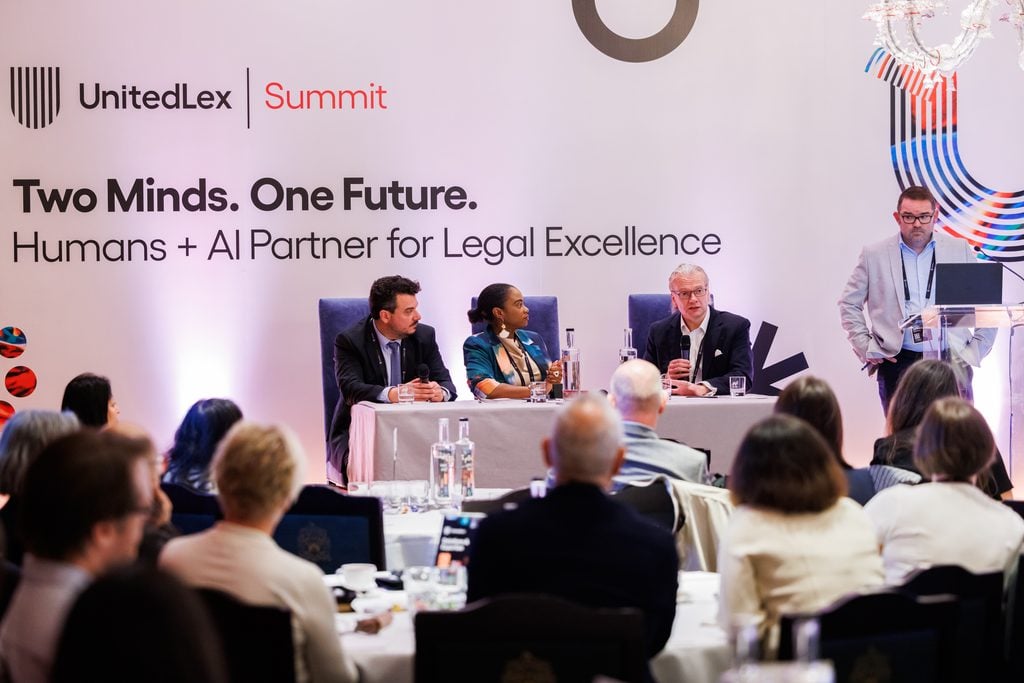
How much control should Legal put around AI? With too little, the business assumes risks that no one has assessed. With too much, the business works around Legal entirely. At the UnitedLex Summit 2026 in London, the Privacy & Compliance panel, “Guardrails for AI Innovation and Adoption,” looked for the line between the two.
The discussion picked up where last year’s contracts panel left off. In “Trusting AI in Contracts“, panelists at the UnitedLex Summit 2025 argued that legal teams need clean, centralized data, a shared AI policy, and trained employees before AI can deliver reliable results. David Gaiser, who spoke on that panel as Head of Legal at UnitedLex, warned that vendor claims can overstate what a tool will actually find. A year later, most organizations have AI tools in use, and the questions have moved from readiness to risk. Who owns it? Who can stop a tool that fails? Who answers for an agent that keeps running after its creator leaves?
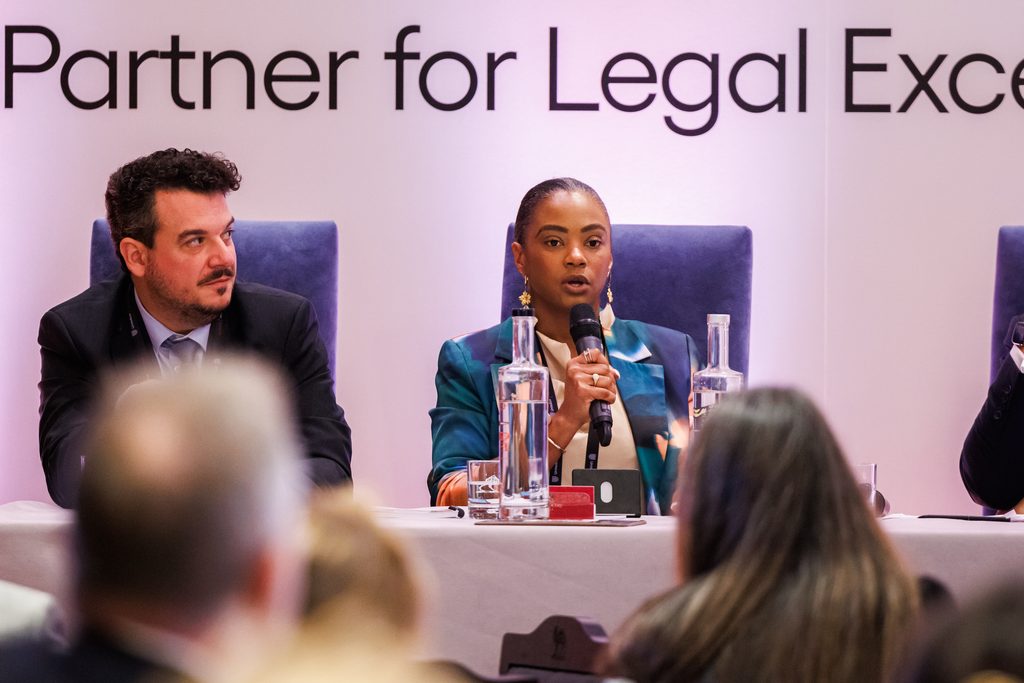
Wendy Everett, Manager of Legal Operations and Outside Counsel Management at UnitedLex, hosted this year’s panel, and David Gaiser, SVP, Contracts, Compliance and Legal Ops at UnitedLex, returned as moderator. The panelists were Ashley Winton, Principal at Winton & Winton; Dr. Idir Laurent Khiar, Data Protection Officer and AI Officer at DPD Baltics; and Claudine Brown, Data Protection Officer at Zilch.
Find the line between too much control and too little
Winton opened by rejecting both extremes. Heavy regulation and stacks of internal reports push the business to work around Legal. A hands-off approach leaves the business doing the bare minimum, and box-ticking impact assessments create their own problem, because the business may later treat them as proof that a risk was approved.
“Neither of those approaches is realistic for your successful adoption of AI,” Winton said.
Share ownership of AI risk
The panel agreed that no single person can own AI risk. Brown explained that AI brings security, privacy, regulatory, ethical, and output risk, and no individual can see all of it.
“You must ask who is responsible for what risk in regards to the AI and what type of risk is that tool going to bring to the business,” Brown said.
Dr. Khiar described a cross-functional AI board where all stakeholders are invited to the table: IT, information security, data, business, legal, and compliance teams map AI risks and address each one by function. This board also tracks shadow AI, because employees who do not get approved tools will find their own.
Winton questioned this model. In Winton’s view, dedicated AI boards will likely fold into the main board as AI becomes part of how the business runs. Brown suggested a middle path. Many AI risks fall into categories the business already manages, and someone already owns regulatory risk, privacy risk, and data risk. Brown’s advice was to rely on those owners and spend new effort only on what AI changes.
Plan for failure, and decide who can switch a tool off
Winton predicted a large wave of AI system failures and litigation, much like the IT failures of the 1990s. Organizations should ask now whether they keep what they would need to defend an automated decision years later, including copies of the model, its weights, and its parameters. Dr. Khiar agreed and said most organizations have not yet faced many of the questions those failures will raise.
Brown pressed further, asking “If an AI tool fails, who has the authority to switch it off? ”If you’re not in a position to do this, then you don’t really own the risk.
Test what vendors tell you
Gaiser described a security questionnaire that a vendor appeared to have completed using a generative AI tool, without fully understanding its own answers. If a response looks too perfect, test it.
Brown described contracts that include standard contractual clauses yet cannot clearly identify where data actually resides. Winton added that AI providers rarely accept meaningful liability, meaning the organization deploying a tool often carries the majority of the risk.
Keep accountability for agents with the organization
An audience member asked about “orphan agents,” meaning AI agents that continue operating after the person who created them leaves the organization. Winton’s answer was direct: legally, the organization remains responsible.
Brown noted that agents can communicate with one another, and that multiple tools working together may be able to re-identify data that was assumed to be anonymized. Dr. Khiar identified strong authentication for agents accessing company systems as an essential control.
Train people before tools go live
Panelists emphasized that policies alone do not change behavior. Brown advocates for face-to-face conversations before high-risk tools are deployed, while Dr. Khiar requires that teams be required to build AI solutions to train future users on the specific risks those tools introduce.
The discussion reinforced a broader point: organizations need employees who understand not only how AI tools work, but also the governance, security, and compliance obligations that come with using them.
Read the full UnitedLex Summit 2026 recap , or contact UnitedLex to discuss AI governance that supports adoption on your team.