






How can organizations use AI to get more value from their intellectual property? At the UnitedLex Summit 2026 in London, the Intellectual Property panel, “Strategy in the Generative AI Era,” looked at where AI helps IP work, where it falls short, and where experienced attorneys still have to lead.
Last year’s IP panel set up the question. In “Creating Effective, Strategic Partnerships for IP Protection“, the 2025 panelists argued that IP teams need partners to scale, that they must tie IP work to business impact, and that AI will save time without replacing human judgment. One panelist went further and said AI is now a requirement for law firms. This year’s panel looked at what that requirement means in daily practice.
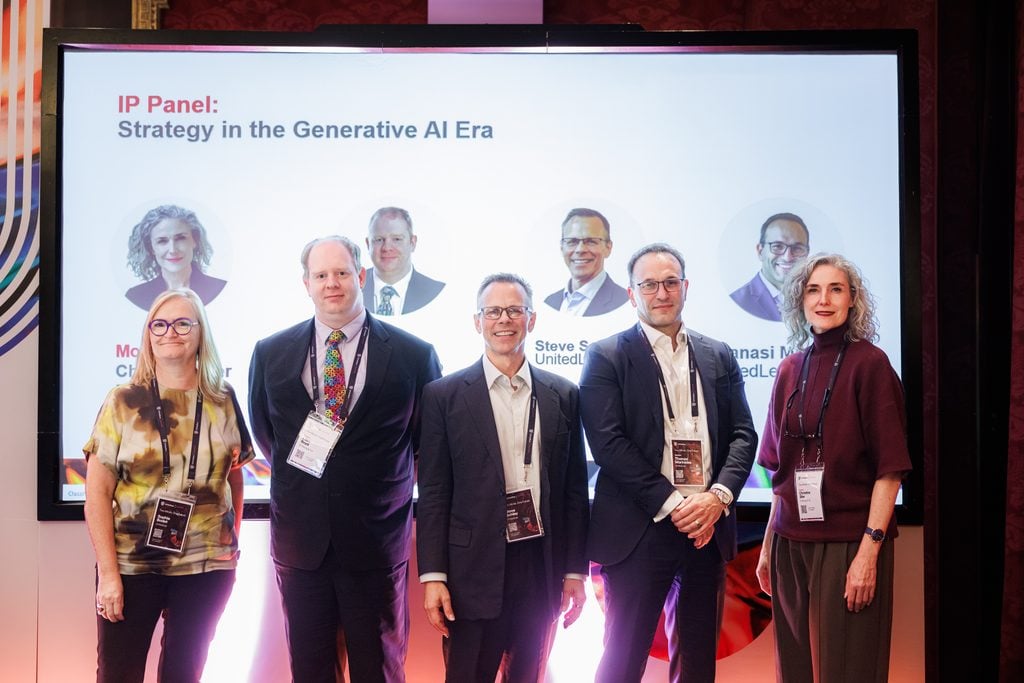
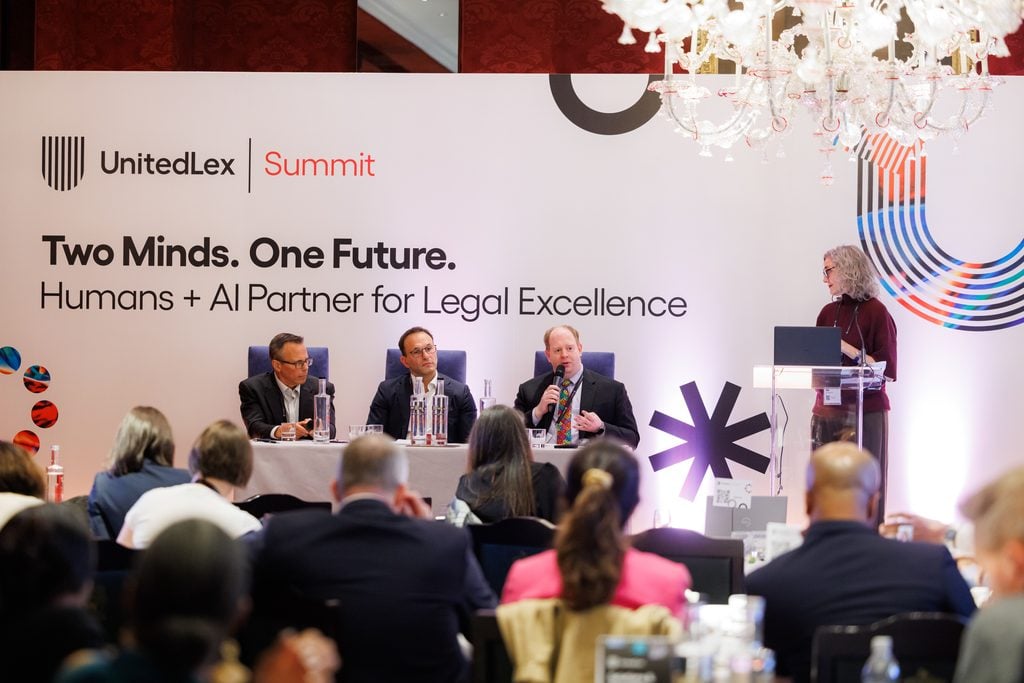
Sophie Bodet, UnitedLex Lead IP Adviser hosted the panel, and Christine Siler, Head of IP Support Services at D Young & Co, moderated the panel. The panelists were Alan Boyd, Partner and Patent Attorney at D Young & Co; Thanasi Marinides, VP, IP Services and Solutions at UnitedLex; and Steve Schley, Chief Revenue Officer at UnitedLex. Siler framed the discussion with a question: if IP is made of ideas, how will AI change the way we decide what has value, how we prove it, and how we protect it?
The attorney still decides
Boyd described how D Young & Co uses a range of tools, from drawing out inventions from engineers to deciding how many applications to file and where. He shared that inventors are increasingly arriving with long AI-generated disclosures. It’s clear they’ve leveraged a tool to help the process along, but an attorney still has to read, test, and distill the material, which can add time and cost. “At the end of the day, it does still need to be guided by an attorney…and I do have to charge you for it.” Boyd said.
Marinides argued that AI helps IP work most when it informs an attorney’s decisions. Writing the text is where it struggles. Model reasoning is impressive, but retrieval across the huge body of patent literature is still hard, and research Marinides cited from the University of South Carolina suggests AI-drafted claims tend to be either too narrow to resist design-arounds or too broad to be granted.
AI changes the partnership, too
IP partnerships are most effective when they are open, two-way relationships where each side is free to challenge the other. Schley showed how AI is changing those relationships. AI use in IP rarely involves one person and one tool. Inventors, in-house counsel, outside counsel, and service providers all take part.
In one long-standing client relationship, he noticed that responses to an initial analysis began coming back with roughly five times as much information, in a day or two instead of a week or two. That created friction, but in Schley’s view it was helpful friction that widened the thinking on both sides.
Confidence is the danger
Boyd’s team spent about two years testing drafting tools. In one early test, a tool stated with confidence that a figure description contained one component. When challenged, it agreed there were two. Asked again, it said one.
A mistake in a filed patent application can be impossible to fix, and the applicant may end up with nothing after disclosing the invention. Boyd sees AI as weak at writing claims, because it reads them as instructions instead of strategy. It does much better at drafting the factual description once the claims and figures are set.
Schley noted that confidence affects the human side too. When a tool flatters the reviewer, its answers become easier to accept. AI is useful as a sparring partner, but the reviewer still has to apply diligence and decide what is enough. Siler, who has built a fully auditable research agent, raised the trade-off every team faces: how much effort it takes to make AI reliable, compared with the time and quality it actually delivers.
Define value before choosing how to use AI
IP teams are increasingly being asked to show how their work supports commercial success to win leadershipbuy-in and budget. Along these lines, Schley urged teams to define value before deciding how to use AI. A patent obtained faster, better, and cheaper is not necessarily a valuable patent.
AI is creating a two-tier pricing model for IP work: companies expect law firms to charge less for routine, lower-value patents that are mainly filed for coverage or volume, because AI makes that work more efficient. However, for high-value patents that could be critical in litigation, licensing, or other strategic business situations, companies are willing to pay the same or even more because they still need deep legal expertise and want those assets to be highly defensible.
Marinides observed that AI has made it much faster to identify potential infringement, which lowers the barrier to enforcement while litigation costs stay high. Boyd added that some clients who expect lower bills still hesitate to approve AI use on their most valuable patents.
Protect what is not yet filed
That hesitation has a basis. Marinides was direct: an unfiled invention disclosure should not go into a public AI platform, because disclosure before filing can put patentability at risk. Self-hosted models are one option, though they need significant investment in hardware and expertise.
Boyd described a long-standing firm policy against putting patent information into search engines and said the same caution now applies to AI. Audience members asked about shadow AI among patent professionals and about AI use by patent offices, which panelists said is focused mostly on search.
Siler closed with a question for the room.”Are we building technology that enhances legal judgment, or systems that will gradually replace it?” Siler asked.
Across both summits, the panels gave a consistent answer. AI can save time and widen the analysis, and the strategy behind each patent still depends on experienced professionals and the partners who work with them.
Read the full UnitedLex Summit 2026 recap or contact UnitedLex to discuss how your IP team can use AI to build stronger patent portfolios.