






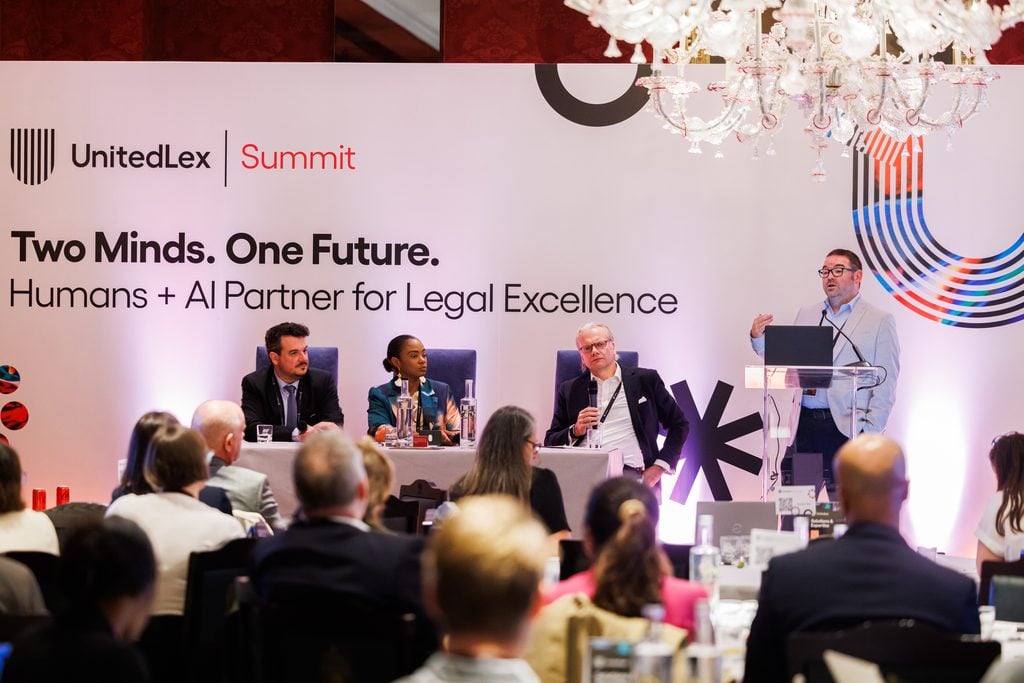
On October 13, 2026, legal leaders from corporate legal departments, law firms, and legal service providers gathered at Grocers’ Hall in London for the UnitedLex Summit. Under the theme “Two Minds. One Future. Humans + AI Partner for Legal Excellence,” the day focused on a question every legal team now faces: how do you move from AI adoption to measurable outcomes without losing the human judgment that gives legal work its value?
The summit started long before the doors opened. Panel topics were shaped by conversations with clients, partners, and peers across the legal industry, and prep calls with every speaker kept each discussion rooted in practice rather than theory. From the moment registration opened and the room began to fill, it was clear that one of the summit’s greatest values was the chance to connect with peers who are all asking the same questions.
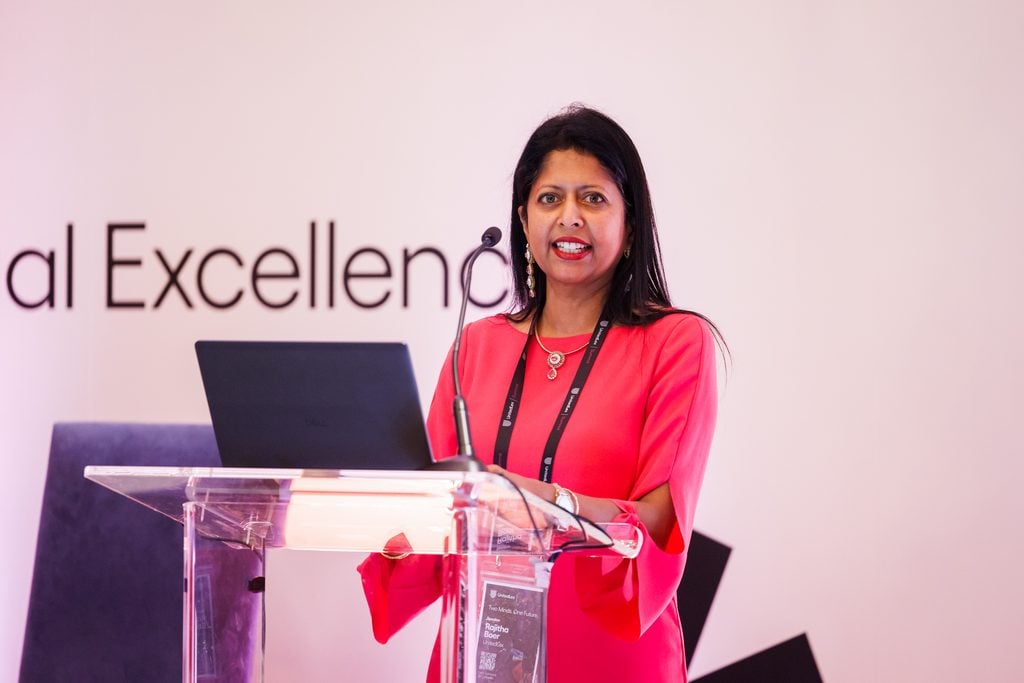
Rajitha Boer, Chief Client Officer, and TJ Collins, President and Chief Operating Officer of UnitedLex and Repario, opened the day before keynote speaker Neil Martin took the stage. Drawing on more than 30 years in motorsport technology, including senior technical roles at McLaren, Red Bull Racing, and Ferrari, Martin connected Formula 1’s data revolution to the legal industry. His message was clear: the future belongs to organizations that treat data and AI as core infrastructure, while keeping humans firmly at the center of critical decisions. Panelists returned throughout the day to one of his points: the question is not whether something will go wrong, but when, and how prepared you are when it does.
Four panels then examined AI through the lens of different legal disciplines, each pairing in-house, law firm, and service provider perspectives so attendees could take away insights applicable to their own roles. The Privacy & Compliance panel asked who owns AI risk and agreed that no single person can, because no one has visibility across privacy, security, regulatory, ethical, and output risk. The Litigation panel debated whether AI is a tool, a teammate, or a “sparring partner” that pressure-tests arguments, and asked a harder question: can we trust what AI finds? The Intellectual Property panel explored where AI adds speed and where human expertise remains irreplaceable, from claim drafting to protecting unfiled inventions. The Legal Ops panel drew a clear parallel with contract lifecycle management (CLM) implementations: the tool might be new, but the challenges are not.
Two interactive workshops gave attendees the chance to put ideas into practice. In “Craft of Conversation,” participants tested legal use cases on their own AI platforms, including a live document review challenge comparing voice and text prompting. In “Rapid Roundtables,” tables debated statements such as “It’s safer to give everyone an approved enterprise AI tool now than to wait for perfect governance” and “AI will weaken the next generation of lawyers unless junior training is deliberately redesigned.”
Across every session, several themes stood out:
- Human judgment remains the differentiator: AI can surface information, draft content, and prioritize review, but strategy, privilege, and claim scope still depend on experienced professionals.
- Accountability cannot be outsourced: AI providers rarely accept meaningful liability, and responsibility for AI outputs, including agents left running, stays with the organization.
- Data and governance come first: AI risk is data risk at scale. Teams need to know what goes into their tools, where it goes, and who has the authority to switch a tool off.
- Adoption determines value: Technology is rarely the primary barrier. Success depends on change management, talent, and measuring productivity, not just usage.
- Skills are shifting: As routine tasks are automated, legal teams must deliberately redesign how junior lawyers learn, and hire for curiosity and adaptability.
The day closed with the Alliance Awards, recognizing select clients for partnership, innovation, and shared success, followed by a networking reception at Grocers’ Hall. A building with more than 600 years of history, it offered a fitting reminder that while AI will transform the legal industry, it is the human mind that creates meaning.
In the coming weeks, UnitedLex will share in-depth recaps of each panel, featuring insights from in-house legal leaders, law firm partners, data protection officers, and patent attorneys. To learn how UnitedLex can help your legal team put AI to work with confidence, contact us here.